Most safety managers spend hours drafting toolbox talk templates from scratch—only to end up with documents that don’t engage workers or meet compliance standards. The truth? A well-structured, professional toolbox talk template can save time, improve retention, and strengthen safety culture—especially when it's free, editable, and ready to deploy.
This guide delivers exactly that: a practical, field-tested toolbox talk template you can download and use immediately. We’ll also break down what makes a template effective, how to customize it, and where teams commonly go wrong.
What Is a Toolbox Talk Template (And Why It’s Not Optional)
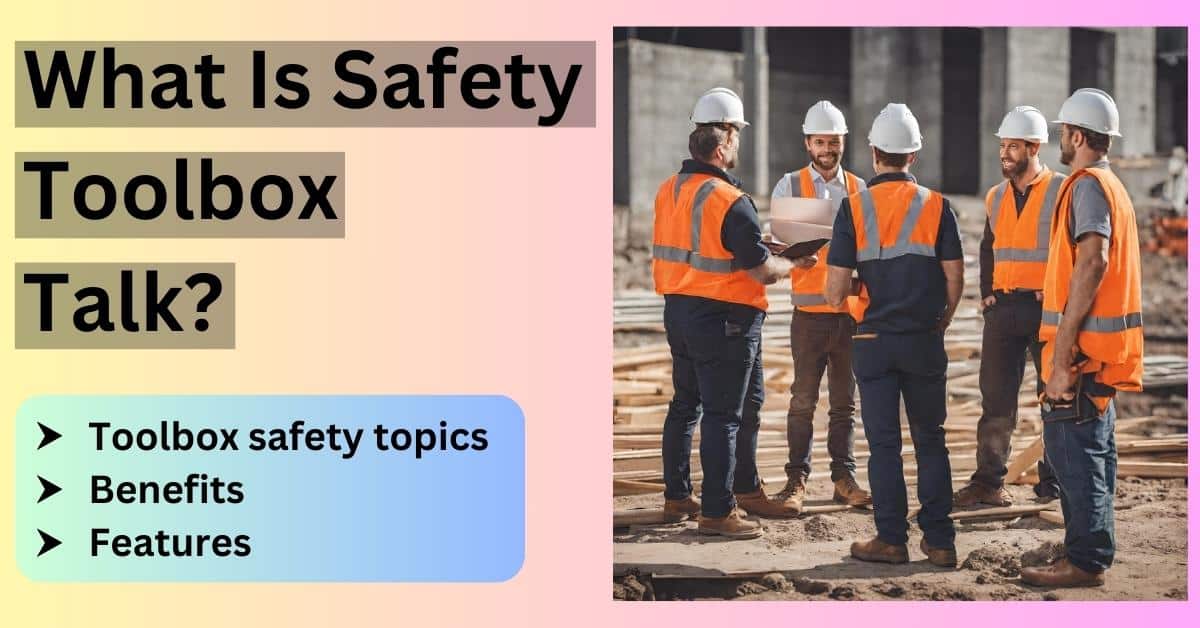
A toolbox talk template is a pre-formatted document used to streamline short, informal safety meetings—typically held at job sites before work begins. These talks address hazards, reinforce procedures, and promote safe behavior.
But a template isn’t just a formality. It’s a control mechanism. Without structure: - Talks become inconsistent or skipped - Critical topics are missed - Compliance risks increase (especially under OSHA or WorkSafe standards) - Workers tune out due to lack of clarity
A solid template ensures every session includes: ✅ Topic introduction ✅ Hazard identification ✅ Control measures ✅ Worker participation ✅ Sign-in sheet
It turns reactive conversations into repeatable safety rituals.
Key Elements of an Effective Toolbox Talk Template
Don’t let a "free" template become a liability. Many downloadable versions miss essential components. The best templates include these six non-negotiable sections:
1. Meeting Header
- Date, time, location
- Supervisor name
- Crew/team name
- Weather or shift details (if relevant)
2. Safety Topic Clear, focused subject (e.g., “Fall Protection at Heights,” “Safe Ladder Use”). Avoid vague titles like “Stay Safe Today.”
3. Hazard Breakdown List 2–4 specific risks tied to the topic. Example:
For "Electrical Safety": - Damaged cords on power tools - Working near live circuits - Lack of lockout/tagout
4. Control Measures Actionable steps to reduce risk:
- Inspect cords before use - Verify LOTO procedures - Use GFCI outlets on outdoor circuits
5. Discussion Prompts Encourage interaction:
- “Has anyone encountered a frayed cord recently?” - “What would you do if you found a live panel open?”
This boosts engagement and surfaces real-time issues.
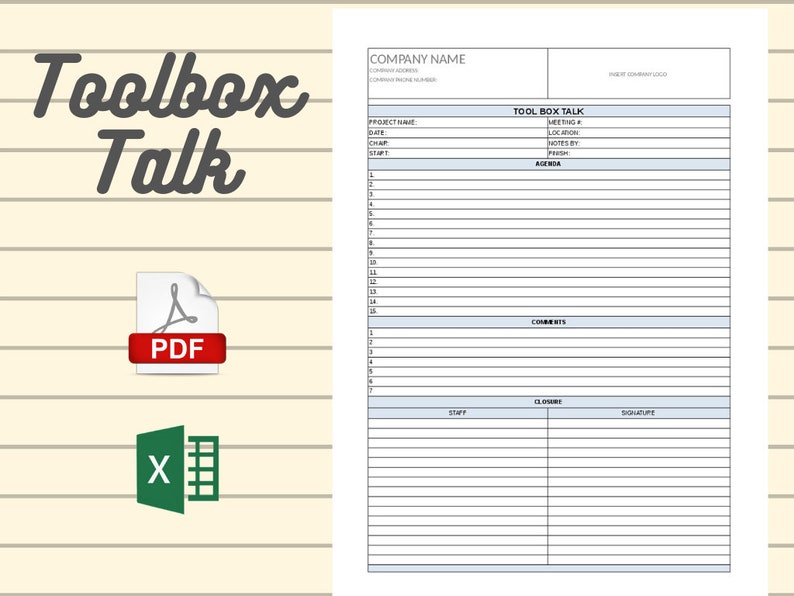
6. Attendance and Sign-Off Signature line for all attendees. This proves compliance during audits.
Common Mistakes That Undermine Toolbox Talks
Even with a good template, poor execution kills effectiveness. Avoid these pitfalls:
❌ Using the Same Template for Every Crew A talk on confined space entry means little to office staff. Customize by team, task, and site.

❌ Skipping the Sign-In Sheet No signatures = no proof. OSHA doesn’t accept verbal meetings as compliant.
❌ Reading Word-for-Word Templates are guides—not scripts. Use them to structure, not dominate, conversation.
❌ Ignoring Worker Feedback If workers raise concerns during a talk, log them and follow up. Otherwise, they’ll stop speaking up.
❌ Failing to Archive Records Store completed talks digitally. Cloud folders beat paper binders for searchability and audit readiness.
Free Toolbox Talk Template: What’s Included in Our Download
We’ve created a no-cost, editable toolbox talk template designed for real-world use. It’s: - Fully customizable (Microsoft Word and PDF formats) - OSHA-aligned with built-in compliance prompts - Field-tested by safety managers in construction, manufacturing, and utilities - Simple to use—just fill in the blanks and go
📥 Download includes: - Master template (.DOCX) - Completed sample (for reference) - Sign-in sheet with space for 15 attendees - Quick-start guide for new supervisors
👉 This isn’t a generic form—it’s a workflow tool that reduces prep time by up to 70%.
Note: No email capture. No upsell. Just a direct download link after form submission (used only for abuse prevention).
5 Best Sources for Free Toolbox Talk Templates
While many sites offer “free” templates, most are bloated with ads or outdated formats. Here are five trusted, practical sources:
| Source | Format | Strengths | Limitations |
|---|---|---|---|
| OSHA.gov | PDF, plain text | Official, compliant, simple | Not customizable, no sign-in |
| SafetyInfo.com | DOC, PDF | 100+ topic-specific templates | Some require registration |
| Creative Safety Supply | DOCX, PDF | Visual, clean layout | Light on discussion prompts |
| HSE.gov.uk | DOC, PDF (UK standards) | Strong hazard focus | Not US-code aligned |
| This Guide (You Are Here) | DOCX + PDF | Editable, includes sign-in, sample | Limited to core topics (expandable) |
Pro Tip: Mix and match. Use OSHA for compliance structure, then pull discussion ideas from SafetyInfo.
How to Customize a Free Template for Maximum Impact
A template is only as good as its adaptation. Follow this workflow:
Step 1: Select the Base Template Choose one with clean formatting and all key sections (use ours or any from the list above).
Step 2: Brand It (If Needed) Add your company logo, safety slogan, or site-specific rules at the top.
Step 3: Tailor the Language Replace formal jargon with crew-friendly terms. > Instead of “Ensure PPE compliance,” say “Do your gloves and hard hat fit right today?”
Step 4: Add Site-Specific Hazards Update templates monthly based on incident trends. > If near-misses involve forklift blind spots, add a visual diagram to the talk.
Step 5: Create a Template Library Save versions for recurring topics:
- Fall protection
- Heat stress
- Hand tool safety
- Emergency response
Label files clearly: Toolbox_Talk_Fall_Protection_v2.docx
Real-World Example: Using a Template After a Near-Miss
Scenario: A worker almost trips over an unmarked cable on a construction site.
Instead of a one-off warning, the supervisor pulls up the “Trip Hazards” template: - Updates the example with the actual incident - Adds a discussion question: “Where else do we see loose cables?” - Circulates the completed talk to all site leads
Result: Two other crews identify and fix similar hazards the same day.
This is how templates turn isolated fixes into systemic improvements.
Why Free Doesn’t Mean Low-Quality
Many assume free templates are generic or outdated. But the best ones come from: - Government agencies (OSHA, HSE) - Industry associations - Safety suppliers giving back
The key is curation. A $200 template won’t protect you more than a well-designed free one—if you use it correctly.
Focus on: - Clarity over design - Practicality over polish - Compliance over flair
Our downloadable template follows these principles. It’s minimal, complete, and built for action—not decoration.
Get Your Free Toolbox Talk Template Now
Stop rewriting the same format every week. Download our free, editable toolbox talk template and start running effective safety meetings in minutes—not hours.
Use it as-is, adapt it to your team, or expand it into a full safety library. Either way, you’re investing in consistency, compliance, and a safer worksite.
👉 Click below to download: [Download Free Toolbox Talk Template – DOCX & PDF]
Equip your team. Document your talks. Stay protected.
FAQ
Where can I find a toolbox talk template in Word format? Our free download includes a fully editable .DOCX file, compatible with Microsoft Word and Google Docs.
Are free toolbox talk templates OSHA compliant? Yes—if they include hazard identification, controls, and attendance records. Our template meets OSHA documentation standards.
How often should toolbox talks be held? Weekly is ideal. High-risk sites may require daily talks. Always hold one after an incident or near-miss.
Can I use the same template for different topics? Yes. Use a master template and swap out the topic, hazards, and controls for each session.
Do I need to store completed toolbox talks? Yes. Keep records for at least one year (or per company policy) for audits and incident investigations.
Should workers sign every toolbox talk? Absolutely. Signatures confirm attendance and understanding. Never skip the sign-in sheet.
Can I modify the free template for my industry? Yes. The template is fully editable for construction, manufacturing, utilities, oil & gas, and more.
FAQ
What should you look for in Free Toolbox Talk Template Download for Safety Teams? Focus on relevance, practical value, and how well the solution matches real user intent.
Is Free Toolbox Talk Template Download for Safety Teams suitable for beginners? That depends on the workflow, but a clear step-by-step approach usually makes it easier to start.
How do you compare options around Free Toolbox Talk Template Download for Safety Teams? Compare features, trust signals, limitations, pricing, and ease of implementation.
What mistakes should you avoid? Avoid generic choices, weak validation, and decisions based only on marketing claims.
What is the next best step? Shortlist the most relevant options, validate them quickly, and refine from real-world results.